
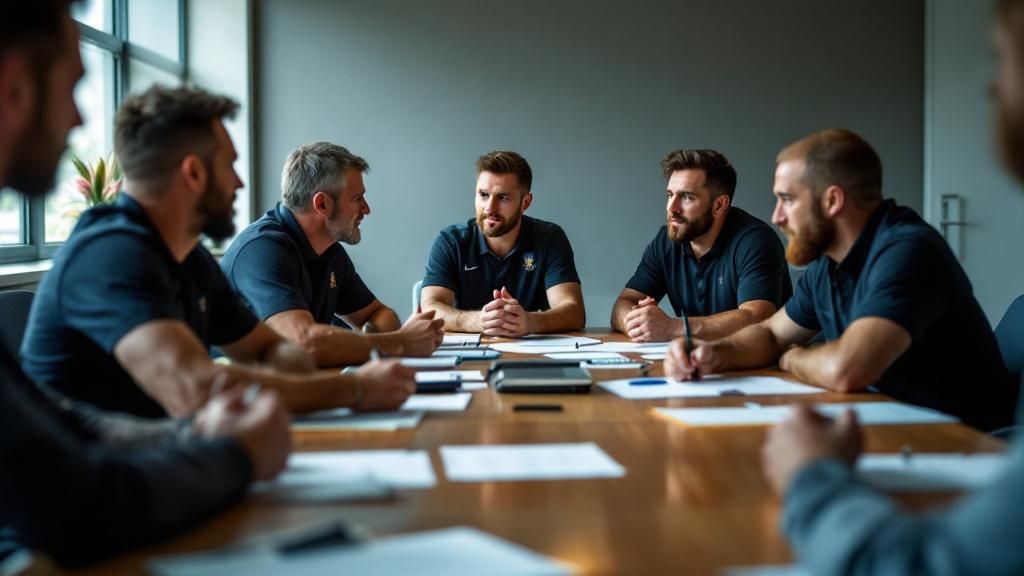
England’s head coach Brendon McCullum met with county cricket coaches and directors on Wednesday as tensions build between the domestic and international game following this winter’s Ashes defeat. The call, which also included England and Wales Cricket Board chief executive Rob Key and performance director Ed Barney, sought to address mounting concerns amongst the counties, who have voiced concerns about the pathway from domestic cricket to the Test team becoming unclear since McCullum and Key assumed their roles in 2022. Surrey head coach Gareth Batty previously described the route as “misted over”, whilst Sussex counterpart Paul Farbrace suggested McCullum has “no interest” in county cricket. The ECB contingent used the meeting to set out their expectations for future England and Lions players, with county coaches indicating they gained clarity on the international team’s goals and immediate priorities.
Restoring Strained Relationships
The Wednesday meeting constituted a significant attempt to bridge a widening divide between the international setup and county cricket. Derbyshire manager Mickey Arthur, speaking at his team’s off-season press conference, stated that the discussion had been constructive, noting the counties “received clarification” on the ECB’s vision. However, whilst Arthur acknowledged the constructive nature of talks, he emphasised that goodwill alone would not suffice. The domestic coaches made clear that any improvements in player development and communication must be substantiated by concrete action on the ground.
The sequence of these endeavours is essential, with England confronting a packed summer commencing with the County Championship’s seven-round preliminary phase before the opening Test match against New Zealand on 4 June. Captain Ben Stokes has previously encouraged players to use this window as a valuable opportunity to make their case for selection in the squad, indicating that county form will carry renewed significance in the selectors’ deliberations. Multiple established England players are arranged to play in the initial matches of fixtures, suggesting a stronger emphasis on domestic cricket as the foundation for international success.
- McCullum and Key detailed their aspirations and near-term aims
- County coaches insisted on action to back up improved communication
- Seven County Championship fixtures lead into New Zealand Test series
- England players urged to use county cricket for selection chances
What the ECB requires from Counties
The ECB delegation leveraged Wednesday’s call to articulate precisely what they expect from county cricket in developing future England and Lions players. Led by McCullum and Key, together with performance director Ed Barney and returning pace bowling lead Troy Cooley, the international contingent outlined their strategic priorities and selection criteria. This clarity of purpose represents a marked shift from the ambiguity that has characterised relations since 2022, when the current leadership took the helm. The ECB’s focus on dialogue signals recognition that the counties deserve transparency about how players progress from domestic cricket to international representation.
The presence of David Court, whose remit covers player identification at the ECB, underscored the organisation’s commitment to closing the divide between grassroots and elite cricket. By assembling the full spectrum of decision-makers—from coaching staff to performance analysts—the ECB sought to show that county cricket continues to be central to their future strategy. However, the effectiveness of these efforts ultimately depends on whether the international team’s stated ambitions translate into concrete backing for domestic cricket and more defined routes for county players seeking Test selection.
Clarity on Recruitment Routes
England’s latest selection philosophy has often prioritised promise over domestic form, a strategy that has occasionally yielded positive results but also created tension with coaches at county level. Jacob Bethell’s selection prior to scoring a first-class hundred and Shoaib Bashir’s selection after merely six first-class matches exemplified this approach. Yet the 4-1 Ashes defeat appears to have prompted recalibration, with the ECB now emphasising the significance of county cricket as a proving ground for players aspiring to international cricket. This constitutes a significant acknowledgment that county form should carry greater weight in selection discussions.
Captain Ben Stokes has reinforced this message, informing the ECB that the seven-match County Championship series before the New Zealand tour constitutes a “great opportunity” for numerous players around the country to stake their claims. With established players like Ollie Pope and Jamie Smith set to play for Surrey, and rising stars including Shoaib Bashir making their debut for Derbyshire, the international team is demonstrating its commitment to the domestic game. This reinvigorated commitment indicates that county cricket is at last receiving the recognition it warrants as the bedrock for Test achievement.
Local County Athletes Seizing Their Moment
With the County Championship poised to start on Friday, England’s players encounter a vital period to prove their worth ahead of the New Zealand Test series in June. The domestic competition will act as a final tryout for those aiming for selection, with several established internationals and promising prospects taking to the field. This offers a concrete chance for county cricketers to influence their Test futures, particularly following the ECB’s renewed emphasis on domestic form as a selection criterion. The championship rounds will certainly be crucial for squad periphery players and developing prospects alike.
| Player | County and Opponent |
|---|---|
| Ollie Pope | Surrey vs Warwickshire |
| Jamie Smith | Surrey vs Warwickshire |
| Matthew Potts | Durham vs Kent |
| Zak Crawley | Kent vs Durham |
| Shoaib Bashir | Derbyshire vs Worcestershire |
| Sam Cook | Essex (opponent TBC) |
Beyond these headline names, county cricket will create key opportunities for lesser-known players to press their case for international honours. Fast bowlers and spin bowlers competing throughout the county season will have real potential to impress the ECB’s scouts and coaching staff. The increased attention on county performances represents a marked change in selection strategy, providing county cricketers genuine hope that consistent performances can result in Test opportunities.
The Future Direction for English Cricket
The peace-building initiatives between the ECB and county cricket constitute a critical juncture for English Test cricket. Following the costly Ashes loss and mounting criticism from domestic coaches, Wednesday’s strategic discussion demonstrates a genuine attempt to reconstruct relationships and develop clearer frameworks for talent progression. By setting out their selection standards and long-term ambitions, McCullum and Key have started tackling fears that the international team had lost touch with the county game. However, as one county coach noted, commitments require measurable progress to restore confidence across the domestic game.
The hiring of Troy Cooley as men’s pace bowling lead and the ECB’s fresh focus on County Championship form indicate a better organised method for identifying and developing players. England’s commitment to focus on domestic cricket ahead of the New Zealand tour reflects a philosophical shift towards building sustainable success. With numerous prominent players already engaged in county action and the selection timeframe clearly defined, the foundation is laid for county cricket to reclaim its deserved place as the talent factory for Test cricketers. The forthcoming period will reveal whether this renewed partnership can genuinely strengthen the foundations of English cricket.
- County Championship starts Friday with seven rounds preceding New Zealand Test series
- ECB officials explained selection criteria and development objectives to county coaching staff
- Captain Ben Stokes advised players to utilise domestic cricket as selection opportunity
